Friday, May 15, 1:45 – 3:45 pm · Talk Room 1
Using cognitive tests to reveal the strengths and limits of brain encoding models
Speaker N Apurva Ratan Murty
Session Beyond Prediction: Interpretable Brain Encoding Models for Understanding Vision
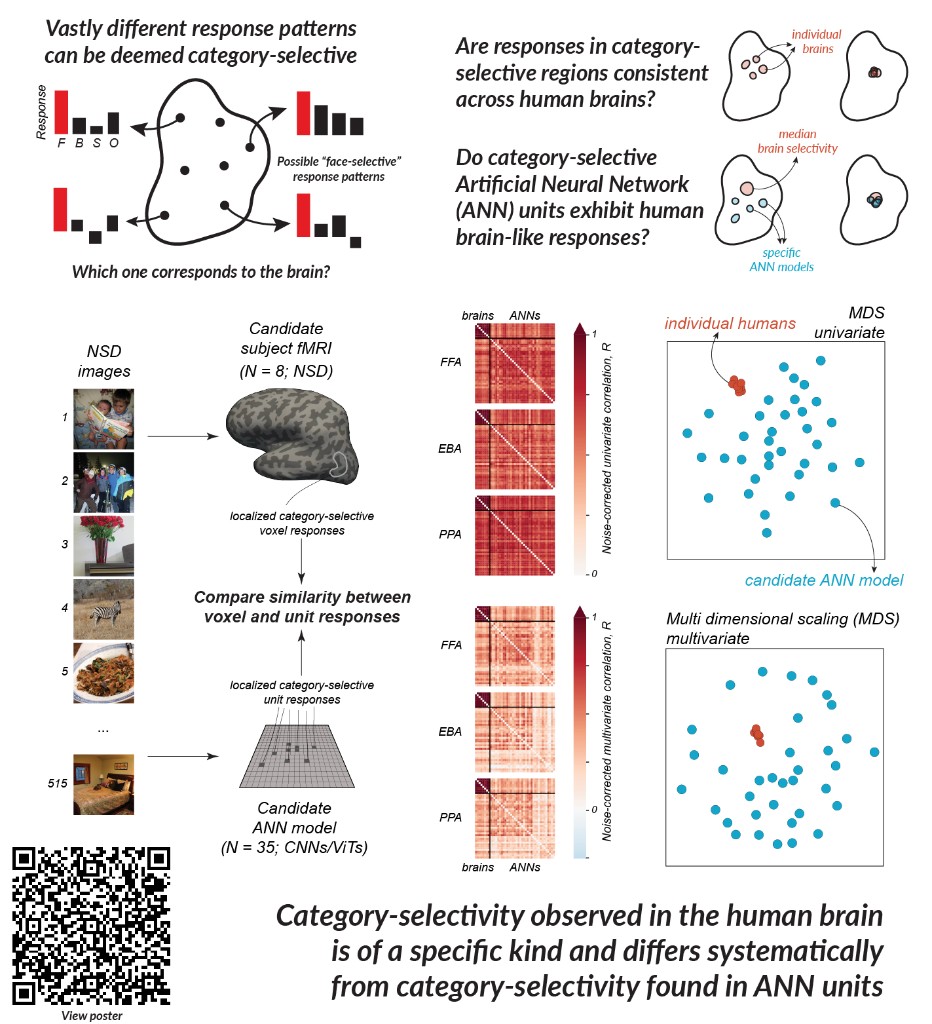
Explore the research our lab is showcasing at the conference, including 1 Symposium Talk, 1 satellite event, 2 talks, 3 posters! Looking forward to connecting!
Friday, May 15, 1:45 – 3:45 pm · Talk Room 1
Speaker N Apurva Ratan Murty
Session Beyond Prediction: Interpretable Brain Encoding Models for Understanding Vision

Sunday, May 17, 12:45 – 2:15 pm · Blue Heron
Organizer Ruolin Wang
Speakers N Apurva Ratan Murty, Nancy Kanwisher, Antônio Mello, Mayukh Deb, Ruolin Wang
Tuesday, May 19, 8:15 – 9:45 am · Talk Room 2
Speaker Ruolin Wang
Session Functional Organization of Visual Pathways 2 · Talk 51.21
Tuesday, May 19, 2:45 – 4:30 pm · Talk Room 1
Speaker Nikolas McNeal
Session Theory · Talk 54.14
Saturday, May 16, 8:30 am – 12:30 pm · Banyan Breezeway
Presenter Kushal Dudipala
Session Undergraduate Just-In-Time 1 · Poster 23.349
Saturday, May 16, 2:45 – 6:45 pm · Pavilion
Presenter Alish Dipani
Session Theory · Poster 26.461
Sunday, May 17, 8:30 am – 12:30 pm · Banyan Breezeway
Presenter Ranjani Koushik
Session Undergraduate Just-In-Time 2 · Poster 33.350
See more fantastic talks and posters from our colleagues!
A re-analysis of 55 experiments reveals two factors that drive confidence for error trials
Herrick Fung · Decision Making
When the Wait Matters: Differences in Cognitive Ability Contributions to Simultaneous vs. Sequential Visual Discrimination
Yoonsang Lee · Decision Making: Perception 1
Probability versus Evidence: Comparing Confidence Models in Multi-Alternative Perceptual Decision Making
Kai Xue · Decision Making: Actions, metacognition
Exploring the Mental Representation of Visualization Complexity through Measurement Methods
Kylie Lin · Perceptual Organization: Grouping
Representation of auditory motion in hMT+ of early blind individuals
Yang YANG · Motion: Mechanisms, models
This satellite event will show how in-silico experimentation can be used as a practical framework for benchmarking computational models of the human brain. It builds directly on our recent efforts (Wang, Deb et al. in prep) that show how prior experiments can be replayed in silico and used to evaluate which findings replicate across candidate brain models and which do not. Participants will be invited to run in-silico experiments of their own design using a drag-and-drop executable modeling platform.
Add to calendar Google Calendar Outlook Apple & others (.ics)
A brief framing of the research motivation behind the platform: how encoding models can move beyond prediction toward replication, teaching, and hypothesis-driven exploration. Also introducing the Lab as a shared workflow for both revisiting published findings and exploring new experimental ideas.
A concise, non-technical primer on how the platform generates model predictions, what participants will see in the outputs, and how to interpret results during the hands-on sessions.
How the platform can support teaching, demonstration, and conceptual understanding in vision science.
Looking into the Past — Replicating Published Findings
Participants use the Lab with curated stimuli from published studies to examine whether model predictions reproduce known experimental findings.
A discussion of what the models captured, where they failed, and what replication successes and failures can reveal about both computational models and cognitive theories.
Looking into the Future — Planning New Experiments
Participants use the same Lab workflow with their own stimuli or modified examples to compare predicted responses across ROIs or models and explore how simulations might refine future experimental hypotheses.
A discussion of how model simulations can help generate hypotheses, sharpen experimental designs, and reveal the limits of current models.